
Learn how to get your business on Google’s first page with proven SEO strategies, Google Business Profile tips, and local SEO advice for Udaipur businesses.
Imagine you’re looking for a café near Fateh Sagar Lake, a dentist in Hiran Magri, or a wedding photographer in Udaipur. Like most people, you’ll probably open Google, type your query, and click one of the first few results.
Now ask yourself this:
If someone searched for your business or the services you offer today, would they find you on the first page, or your competitors?
This question has become more important than ever. Whether you own a restaurant, salon, clinic, gym, coaching institute, boutique, or construction company, your customers are searching online before making a decision. If your business doesn’t appear where they’re looking, you could be missing valuable opportunities every day.
The good news is that getting your business on Google’s first page isn’t about luck or paying Google for a top spot. It’s about building a strong online presence that helps Google understand, trust, and recommend your business.
In this guide, you’ll learn how Google ranks businesses, what factors influence your visibility, and the practical steps you can take to improve your chances of appearing on the first page, especially if you serve customers in Udaipur.
What Does It Mean to Rank on Google’s First Page?
When people talk about getting on “Google’s first page,” they mean appearing among the top organic search results when someone searches for a relevant keyword.
For example:
| Search Query | Ideal Business |
| Best café in Udaipur | Local café |
| Dentist near me | Dental clinic |
| Interior designer Udaipur | Interior design firm |
| Best gym in Udaipur | Fitness centre |
Google typically shows 10 organic results on the first page, along with features such as:
- Google Business Profile listings
- Google Maps
- Featured Snippets
- AI Overviews
- People Also Ask
- Images
- Videos
- Reviews
This means there are now multiple ways for your business to gain visibility, not just through a traditional website ranking.
Organic Results vs Paid Ads
Many business owners believe they must pay Google to appear first. That’s not entirely true.
| Paid Ads | Organic SEO |
| Immediate visibility | Long-term visibility |
| Stops when budget ends | Continues attracting traffic |
| Cost per click | No cost per click |
| Advertisement | Earned ranking through SEO |
Paid advertising can be useful for quick results, but strong SEO helps build sustainable visibility over time.
Why the First Page Matters More Than Ever
Think about your own search habits.
When was the last time you clicked on page two of Google?
Most people don’t.
Studies consistently show that the majority of clicks go to the first page, with the top few results receiving the highest share of attention. As search behavior evolves with AI Overviews and richer search results, visibility at the top has become even more valuable.
For local businesses, appearing prominently can lead to:
- More website visitors
- More phone calls
- More direction requests on Google Maps
- More inquiries
- More foot traffic
- Greater brand credibility
Imagine two salons in Udaipur offering similar services at similar prices.
One appears in the top search results with strong reviews, updated photos, and useful website content.
The other has an outdated website, few reviews, and no optimized Google Business Profile.
Which one do you think potential customers are more likely to contact?
In many cases, the difference isn’t the quality of service,it’s online visibility.
Suppose someone searches:
“Best rooftop restaurant in Udaipur.”
Google doesn’t simply choose the restaurant with the best food. Instead, it evaluates many signals, including:
- Relevance to the search
- Business information
- Customer reviews
- Website quality
- Location
- Popularity
- Overall trustworthiness
Businesses that consistently maintain these signals are more likely to appear higher in search results.
How Google Decides Which Businesses Appear First
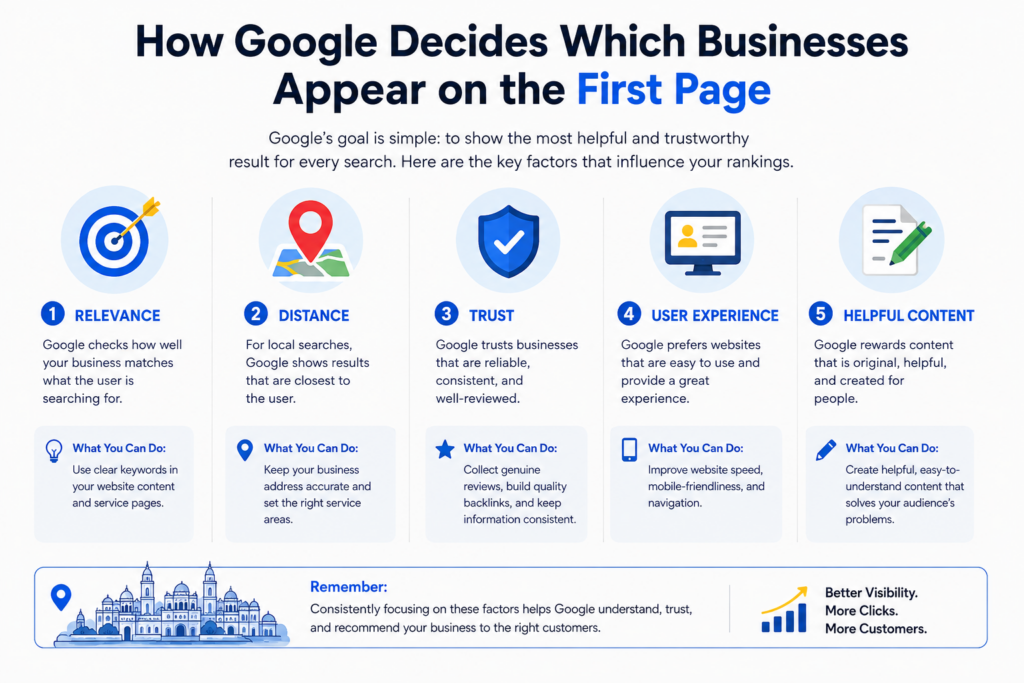
Google’s goal is simple: Show the most helpful and trustworthy result for every search.
To do that, it analyzes hundreds of ranking signals. While Google doesn’t reveal its exact algorithm, years of research and official guidance show several core factors that consistently influence rankings.
Instead of focusing on shortcuts or “SEO hacks,” successful businesses improve the areas that matter most.
1. Relevance
Google first asks:
Does this business actually match what the user is searching for?
If someone searches:
“Best dermatologist in Udaipur”
Google is unlikely to rank:
- A dental clinic
- A beauty salon
- A pharmacy
Even if those businesses have excellent websites.
Your website content, page titles, headings, service descriptions, and Google Business Profile should clearly communicate what you offer.
2. Distance
For local searches, location plays a major role.
Someone searching:
“Bakery near me”
will usually see businesses located close to their current location.
That’s why it’s important to:
- Keep your address accurate
- Define your service areas correctly
- Maintain a complete Google Business Profile
- Use consistent business information across the web
3. Trust
Google prefers businesses that appear reliable.
Some trust signals include:
- Positive customer reviews
- High-quality backlinks
- Secure HTTPS website
- Consistent business information
- Updated website
- Expert-written content
- Clear contact information
Think of trust like your business’s online reputation.
The stronger your reputation, the more confidence Google has in recommending your business.
4. User Experience
Even if your website contains excellent information, visitors may leave quickly if it:
- Loads slowly
- Doesn’t work well on mobile devices
- Is difficult to navigate
- Has confusing layouts
- Contains outdated information
Google pays attention to how users interact with your website because it wants to recommend pages that provide a positive experience.
5. Helpful Content
Google’s Helpful Content System rewards websites that genuinely answer users’ questions.
Instead of publishing pages filled with keywords, focus on creating content that educates, solves problems, and reflects your expertise.
For example, if you own a dental clinic in Udaipur, publishing articles such as:
- “How Often Should You Get a Dental Check-Up?”
- “What to Expect During Root Canal Treatment”
- “How to Choose the Right Dentist in Udaipur”
can help build trust with both readers and search engines.
Before trying advanced SEO techniques, understand this simple principle:
Google doesn’t rank businesses because they ask to be ranked, it ranks businesses that provide the most relevant, trustworthy, and helpful experience for users.
Every SEO strategy we’ll discuss in the next section is designed to strengthen one or more of these signals.
10 Proven Ways to Get Your Business on Google’s First Page
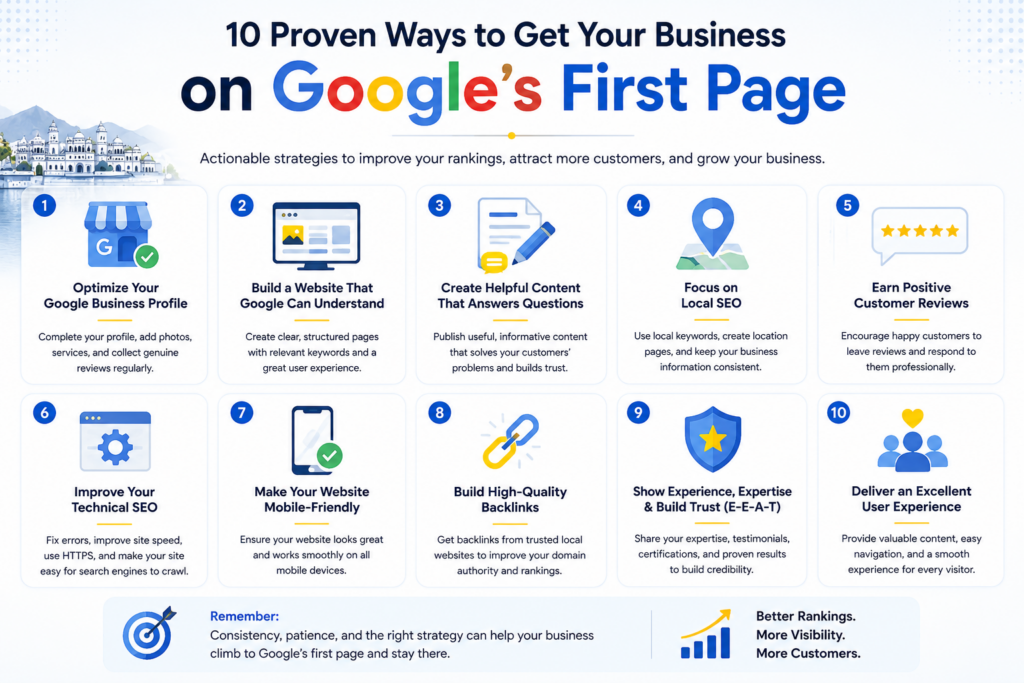
Now that you understand how Google decides which businesses deserve to rank, let’s focus on what you can actually do.
There’s no single trick that instantly moves your business to the first page. Instead, businesses that consistently rank well usually excel across several key areas. Think of SEO as building a strong foundation, each improvement makes your online presence more trustworthy and useful.
Let’s explore the strategies that matter most.
1. Optimize Your Google Business Profile
If you serve customers locally, your Google Business Profile (GBP) is one of the most powerful tools for improving visibility.
When someone searches for:
- Restaurant near me
- Salon in Udaipur
- Dentist near Fateh Sagar
- Best gym in Udaipur
Google often displays the Local Pack, the map with three business listings, before the traditional website results.
Appearing here can lead to more calls, direction requests, website visits, and walk-in customers.
Your Google Business Profile Checklist
✔ Claim and verify your profile
✔ Choose the correct business category
✔ Add accurate business hours
✔ Write a detailed business description
✔ Upload high-quality photos
✔ Add your services and products
✔ Keep your phone number and address updated
✔ Answer customer questions
✔ Publish regular updates
✔ Encourage genuine customer reviews
2. Build a Website That Google Can Understand
Many business owners believe simply having a website is enough.
In reality, Google needs to understand what your website is about.
Every important service should have its own dedicated page.
Instead of one generic page saying:
“We offer digital services.”
Create focused pages like:
- Local SEO Services
- Website Design
- Google Business Profile Optimization
- Technical SEO Audit
- Content Marketing
This makes it easier for both visitors and search engines to understand your expertise.
Essential On-Page SEO Checklist
| SEO Element | Best Practice |
| SEO Title | Include your primary keyword naturally |
| Meta Description | Explain the page in 140–160 characters |
| H1 Heading | One clear H1 per page |
| H2 & H3 | Organize content logically |
| Images | Compress and add descriptive ALT text |
| URL | Short, readable, keyword-focused |
| Internal Links | Connect related pages |
| Mobile Design | Responsive layout |
| HTTPS | Secure website |
| Fast Loading | Improve Core Web Vitals |
A well-structured website helps both users and Google navigate your content more effectively.
3. Create Helpful Content That Answers Real Questions
Google has become much better at recognizing content that genuinely helps users.
Instead of asking:
“How many times should I use my keyword?”
Ask:
“What questions does my customer have before making a purchase?”
Helpful content builds trust, attracts visitors, and demonstrates your expertise.
Content Ideas for Local Businesses
| Business | Blog Ideas |
| Dentist | Signs You Need a Root Canal |
| Restaurant | Best Family Dinner Spots in Udaipur |
| Gym | Beginner Workout Tips |
| Builder | How to Choose the Right Construction Company |
| Salon | Bridal Makeup Preparation Guide |
| Interior Designer | Home Design Trends in Udaipur |
When your content solves real problems, Google is more likely to recommend it.
Pro Tip
Don’t just write about your services.
Write about your customers’ questions, concerns, and goals.
4. Focus on Local SEO
If your customers are in Udaipur, your SEO strategy should also be local.
Google wants to show nearby businesses that best match the user’s search.
Improve Your Local Presence By:
- Mentioning your city naturally throughout your website
- Creating location-specific service pages
- Embedding Google Maps
- Keeping your Name, Address, and Phone Number (NAP) consistent
- Building local citations
- Participating in local events and communities
Example
Instead of saying:
“We provide SEO services.”
Say:
“We help businesses across Udaipur improve their visibility on Google through customized SEO strategies.”
This tells Google exactly where your services are relevant.
5. Earn Positive Customer Reviews
Reviews influence both customer decisions and local search visibility.
When multiple businesses offer similar services, reviews often become the deciding factor.
Encourage Reviews By:
- Asking satisfied customers politely
- Sharing a review link after completing a service
- Responding to every review
- Thanking customers for positive feedback
- Addressing concerns professionally
What Not to Do
Buy fake reviews
Offer incentives for positive ratings
Post reviews from fake accounts
Google can detect suspicious review patterns, and they may harm your credibility.
6. Improve Your Website’s Technical SEO
Technical SEO ensures search engines can easily access, understand, and index your website.
Even the best content may struggle to rank if technical issues prevent Google from crawling your pages properly.
Technical SEO Checklist
| Check | Why It Matters |
| HTTPS | Builds trust |
| XML Sitemap | Helps Google discover pages |
| Robots.txt | Controls crawling |
| Mobile-Friendly Design | Essential for mobile users |
| Fast Loading Speed | Improves user experience |
| Broken Link Fixes | Prevents poor navigation |
| Clean URL Structure | Easier indexing |
| Image Compression | Faster page speed |
Technical SEO may seem complex, but resolving these issues creates a stronger foundation for all your other SEO efforts.
7. Make Your Website Mobile-Friendly
More than half of all searches now happen on smartphones.
If visitors have to zoom, struggle to navigate, or wait several seconds for pages to load, they’ll likely leave.
Google notices this behavior.
A Mobile-Friendly Website Should:
- Load quickly
- Display correctly on all screen sizes
- Use readable font sizes
- Have clickable buttons
- Offer simple navigation
- Avoid intrusive pop-ups
8. Build High-Quality Backlinks
A backlink is simply another website linking to yours.
Think of backlinks as recommendations.
When trustworthy websites mention your business, Google gains additional confidence in your credibility.
Quality Matters More Than Quantity
One link from a respected local news website is often more valuable than dozens of low-quality directory links.
Ways to Earn Backlinks
- Publish useful resources
- Create original research
- Share local case studies
- Partner with local organizations
- Sponsor community events
- Write guest articles
- Get featured in local media
Avoid buying backlinks or participating in link schemes, as these practices can negatively affect your rankings.
9. Demonstrate Experience, Expertise, Authoritativeness, and Trust (E-E-A-T)
Google increasingly rewards websites that demonstrate genuine expertise and credibility.
Ask yourself:
- Does your website clearly explain who you are?
- Do visitors know why they should trust your advice?
- Have you shared real examples or case studies?
- Is your contact information easy to find?
Ways to Strengthen E-E-A-T
✔ Create an informative About Us page
✔ Showcase customer testimonials
✔ Display certifications or awards
✔ Add author profiles to blog posts
✔ Share real business experiences
✔ Keep content updated
✔ Provide accurate contact information
Trust isn’t built overnight, but it’s one of the strongest long-term advantages in SEO.
10. Deliver an Excellent User Experience
Google wants users to find answers quickly and enjoy using your website.
A positive experience encourages visitors to stay longer, explore more pages, and engage with your content.
Improve User Experience By:
- Using short paragraphs
- Breaking up content with headings
- Including images and graphics
- Adding tables and checklists
- Making navigation simple
- Keeping important information easy to find
Remember:
SEO isn’t just about pleasing search engines, it’s about helping people.
When users have a great experience, search engines often notice too.
Realistic Expectations
Many business owners ask:
“How long does it take to get on Google’s first page?”
The honest answer is:
It depends.
Factors such as your industry, competition, website quality, content, and existing online presence all influence the timeline.
SEO is a long-term investment rather than a one-time task. Businesses that consistently improve their websites, publish helpful content, maintain their Google Business Profile, and earn customer trust are more likely to see sustainable growth over time.
Instead of chasing shortcuts, focus on building a website that genuinely deserves to rank.
Common SEO Mistakes That Stop Businesses from Reaching Google’s First Page
Many business owners invest time and money into their websites but unknowingly make mistakes that limit their visibility. Avoiding these common issues can be just as important as implementing new SEO strategies.
1. Expecting Overnight Results
SEO is a long-term strategy. Unlike paid ads, organic rankings are built gradually as Google gains confidence in your website.
Instead:
- Be patient.
- Publish consistently.
- Monitor performance.
- Make regular improvements.
2. Ignoring Google Business Profile
Many local businesses focus only on their website and forget about their Google Business Profile.
If your profile has:
- Outdated hours
- Old photos
- Incorrect contact details
- Few reviews
you may lose potential customers before they even visit your website.
3. Publishing Thin or Duplicate Content
A 300-word page with little value is unlikely to compete against comprehensive, helpful resources.
Avoid:
- Copying competitors’ content.
- Using AI-generated text without reviewing or improving it.
- Publishing multiple pages targeting the exact same keyword.
Focus on creating original content that genuinely helps your audience.
4. Keyword Stuffing
Years ago, repeating the same keyword dozens of times could influence rankings.
Today, it often has the opposite effect.
Instead of writing:
“Our SEO company in Udaipur provides the best SEO services in Udaipur for businesses in Udaipur.”
Write naturally:
“We help local businesses in Udaipur improve their visibility on Google through customized SEO strategies.”
Google understands context far better than it used to.
5. Forgetting Mobile Users
If your website is difficult to use on a smartphone, visitors are likely to leave quickly.
Always test your website on:
- Android devices
- iPhones
- Tablets
- Different browsers
A mobile-friendly experience is no longer optional.
6. Not Tracking Performance
Without data, it’s difficult to know what’s working.
Monitor metrics such as:
- Organic traffic
- Keyword rankings
- Phone calls
- Contact form submissions
- Google Business Profile insights
- Website conversions
Regular tracking helps you make informed decisions rather than relying on guesswork.
Optimizing for AI Overviews, Featured Snippets & People Also Ask
Search is evolving rapidly. Instead of showing only a list of blue links, Google now displays AI-generated summaries, Featured Snippets, and People Also Ask boxes for many searches.
To improve your chances of appearing in these results:
Answer Questions Clearly
Use direct, concise answers immediately after each heading.
Example: How long does it take to rank on Google’s first page?
SEO results vary depending on competition, website quality, and your strategy. While some improvements may be visible within a few months, sustainable rankings usually require consistent optimization over time.
Use Lists and Tables
Search engines often extract:
- Numbered steps
- Bullet points
- Comparison tables
- Definitions
These formats make your content easier for both readers and search engines to understand.
Your 90-Day SEO Action Plan
Improving your Google rankings doesn’t happen overnight. Breaking the process into manageable steps makes it easier to stay consistent.
| Timeframe | Focus |
| Days 1–30 | Claim or optimize your Google Business Profile, fix website issues, improve page titles, add contact information, ensure mobile responsiveness. |
| Days 31–60 | Publish helpful blog content, request customer reviews, optimize service pages, improve internal linking, and update images with descriptive ALT text. |
| Days 61–90 | Build local backlinks, monitor rankings, refine existing content, publish FAQs, and continue improving user experience. |
Consistency is more valuable than trying to complete everything at once.
Frequently Asked Questions
1. Do I need to pay Google to rank on the first page?
No. Organic search rankings are earned through SEO. Paid ads can provide immediate visibility, but they are separate from organic rankings.
2. Is Google Business Profile important?
Yes. For local businesses, a well-optimized Google Business Profile can significantly improve visibility in Google Search and Google Maps.
3. Can I do SEO myself?
You can learn and implement many SEO fundamentals on your own. However, businesses in competitive industries may benefit from working with experienced SEO professionals for a more comprehensive strategy.
Also Read: How to Get More Customers from How to Get More Customers from Google in Udaipur Google in Udaipur
Conclusion
Getting your business on Google’s first page isn’t about finding shortcuts or trying to outsmart the algorithm. It’s about building a website and online presence that genuinely deserve to be recommended.
By optimizing your Google Business Profile, creating helpful content, improving your website’s technical health, earning customer trust, and focusing on local SEO, you can steadily increase your visibility where it matters most.
If you’re a business owner in Udaipur, remember that SEO is an ongoing process. Small improvements made consistently can lead to meaningful long-term growth.
The goal isn’t just to rank higher, it’s to make it easier for the right customers to find your business when they’re searching for the products or services you offer.
About the Author

Richa Meena
SEO Specialist at ImmortalSEO with expertise in technical SEO and content optimization.
View all posts