
If you run any business, you’ve probably heard the phrase “Core Web Vitals” thrown around by a developer or an SEO agency, usually right after they’ve told you your website is “slow.” Core Web Vitals for SEO in 2026 remain one of the clearest, most measurable ways Google judges whether visiting your website feels smooth or frustrating. And for a growing number of Udaipur businesses competing for the same local searches, that difference can quietly decide who shows up higher on Google.
This guide explains what Core Web Vitals actually are, why they matter for local SEO in 2026, and what you can realistically do about them, without needing to write a single line of code.
What Are Core Web Vitals?
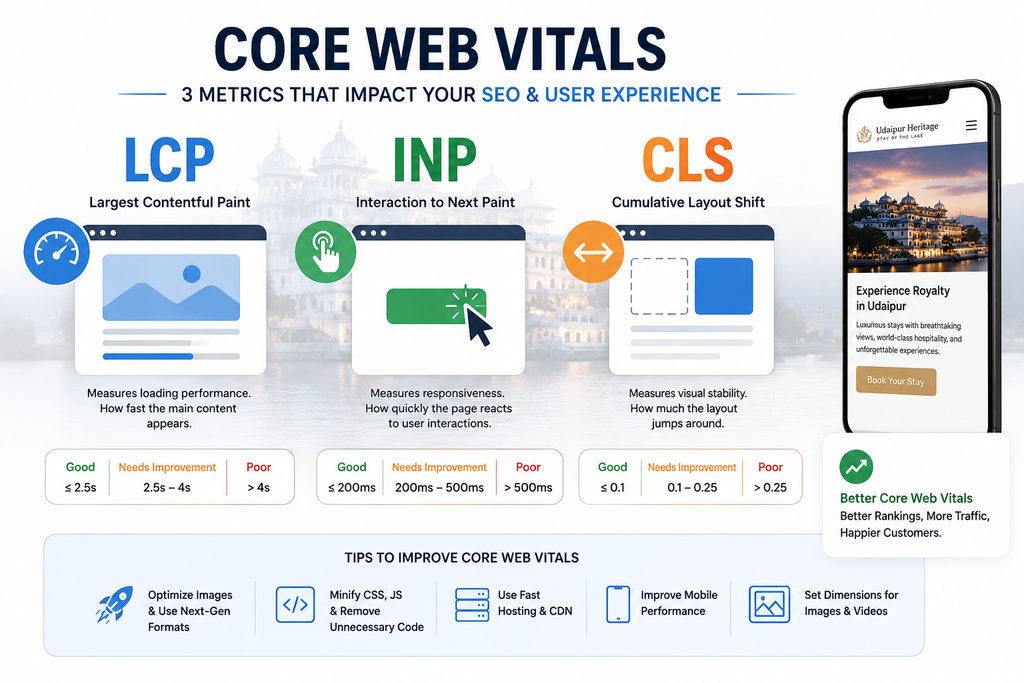
Core Web Vitals are a set of three measurements Google uses to judge the real-world experience of using a webpage. They look at how fast the main content appears, how quickly the page responds when someone taps or clicks something, and how much the layout jumps around while loading.
Think of it like this: two restaurants in Udaipur might serve the same quality of food, but if one has a two-hour wait and confusing seating, customers walk away frustrated, even if the food was great. Core Web Vitals measure that “wait and confusion” experience for your website.
Google has used these signals as part of its page experience ranking factors since 2021, and by 2026 they’ve become a standard, expected part of technical SEO, not an optional extra.
The Three Core Web Vitals Explained
LCP — Largest Contentful Paint
LCP measures how long it takes for the biggest visible element on your page, usually a hero image, banner, or heading, to fully load. If a visitor lands on your hotel’s homepage and stares at a blank screen for four seconds before the main image appears, that’s a poor LCP.
- Good: 2.5 seconds or less
- Needs improvement: 2.5–4 seconds
- Poor: Over 4 seconds
INP — Interaction to Next Paint
INP replaced an older metric called First Input Delay in 2024 and measures how responsive your site feels overall, from the moment someone clicks a button, fills a form, or opens a menu, to the moment the page visibly reacts. A salon’s booking button that takes a full second to respond after being tapped creates a laggy, cheap-feeling experience, even if the site looks polished.
- Good: 200 milliseconds or less
- Needs improvement: 200–500 milliseconds
- Poor: Over 500 milliseconds
CLS — Cumulative Layout Shift
CLS measures visual stability, how much your page’s content jumps around as it loads. You’ve likely experienced this yourself: you go to tap a menu item on a restaurant’s website, and right before your finger lands, an ad or image loads and shifts everything down, so you accidentally click the wrong thing. That’s a CLS problem.
- Good: 0.1 or less
- Needs improvement: 0.1–0.25
- Poor: Over 0.25
Why Core Web Vitals Matter for SEO in 2026
Google’s Page Experience Signal
Core Web Vitals sit inside a broader group of signals Google calls “page experience,” alongside mobile-friendliness and safe browsing. While great content and strong backlinks still carry more ranking weight, Core Web Vitals act as something closer to a tie-breaker. When two Udaipur businesses are targeting the same keyword, say, “best hotel near City Palace”, with similarly strong content, the site with the smoother technical experience has a genuine edge.
It’s also worth being direct here: no legitimate SEO practice, including fixing Core Web Vitals, can promise you the 1st ranking or guaranteed results. What good technical SEO does is remove a real disadvantage that could otherwise be holding a strong business back.
The Local Search Connection
For Udaipur businesses, most traffic doesn’t come from generic national searches, it comes from local intent: “spa near Fateh Sagar,” “AC repair Udaipur,” “best CA for GST filing Udaipur.” These searchers are often on mobile data, sometimes on 4G in areas with patchy connectivity, and they’re comparison-shopping between multiple local options in the same few minutes. A slow-loading page at that moment doesn’t just hurt your SEO, it loses you the customer to a competitor’s site that opened first.
This is also why Core Web Vitals connect directly to your Google Business Profile performance. When people click through from your Maps listing or local pack result to your website, a fast, stable landing experience reinforces the trust your GBP reviews and photos already built. A slow, jumpy website undoes that trust instantly.
How Core Web Vitals Affect Real Udaipur Businesses
Example — A Lake Pichola Hotel Booking Page
Imagine a heritage hotel near Lake Pichola with a beautiful, photo-heavy homepage. If those high-resolution images aren’t compressed, LCP could easily creep past 5–6 seconds on mobile. A traveler searching “lake view hotel Udaipur” on their phone, standing at a train station with limited patience, may abandon the page before ever seeing the booking button, a lost reservation, not just a lost ranking point.
Example — A Local Clinic’s Appointment Form
A clinic’s “Book Appointment” form might load fine, but if scripts for chat widgets, ads, or booking plugins are poorly optimized, tapping the “Submit” button might lag or misfire, a poor INP score. A patient trying to book a same-day appointment isn’t going to retry three times; they’ll call a competitor instead.
How to Check Your Core Web Vitals Scores
You don’t need paid tools to get started. These are free and reliable:
| Tool | Best For | Access |
| Google Search Console | Real visitor data over time, grouped by URL | Free, requires site verification |
| PageSpeed Insights | Instant single-page test with specific fixes | Free, no login needed |
| Chrome DevTools (Lighthouse) | Developer-level diagnostics | Free, built into Chrome browser |
Quick check: Go to PageSpeed Insights, paste in your homepage URL, and look at the “Core Web Vitals Assessment” section. If it says “Failed,” that’s your starting signal to dig deeper, not a reason to panic.
Common Causes of Poor Core Web Vitals (and Quick Fixes)
- Uncompressed images → Use modern formats like WebP and compress images before uploading; this alone often fixes LCP issues.
- Too many plugins or widgets (common on WordPress sites for salons, clinics, and coaching centres) → Audit and remove unused plugins; each one adds loading weight.
- No caching or slow hosting → Use a reputable hosting provider and enable browser/server caching.
- Ads or embeds loading without reserved space → Set fixed width/height for images, videos, and ad slots so nothing shifts as it loads.
- Render-blocking scripts → Defer non-essential JavaScript (chat widgets, tracking pixels) so they load after the main content.
- Web fonts causing layout jumps → Preload key fonts or use system fonts where design allows.
What Core Web Vitals Won’t Fix (Setting Realistic Expectations)
It’s tempting to treat Core Web Vitals as a silver bullet, but they’re one piece of a much larger SEO picture. A technically fast website with thin, unhelpful content still won’t outrank a slightly slower competitor with genuinely useful, well-optimized content. Core Web Vitals improve experience, not relevance, you still need strong on-page SEO, quality backlinks, accurate Google Business Profile information, and content that actually answers what local searchers are asking.
Any agency promising that fixing your Core Web Vitals alone will guarantee top rankings isn’t being fully honest with you. Treat it as removing a handicap, not installing a shortcut.
How Immortal SEO Approaches Core Web Vitals for Local Clients
At Immortal SEO, we treat Core Web Vitals as one diagnostic layer within a full local SEO audit, not a standalone fix. For Udaipur businesses, our process typically involves:
- Running a full technical audit across your key pages (homepage, service pages, booking/contact forms)
- Prioritizing fixes by actual visitor impact, not just the “score”, a slow page with high traffic matters more than a fast page nobody visits
- Pairing technical fixes with content and local SEO work, since Vitals alone rarely move rankings in isolation
- Re-testing and reporting transparently, month over month, so you can see real change, not vague promises
We don’t guarantee specific rankings, and we’re upfront when a website needs a rebuild rather than a patch. Our goal is a website that performs well for your customers first, which naturally supports how it performs for Google.
FAQs
Q: Do Core Web Vitals really affect Google rankings in 2026?
Yes, but as one of many ranking factors. They matter more as a tie-breaker between similarly strong competitors than as a standalone ranking booster.
Q: What is a good Core Web Vitals score?
Good benchmarks are LCP under 2.5 seconds, INP under 200 milliseconds, and CLS under 0.1, as measured in Google Search Console or PageSpeed Insights.
Q: Can I improve Core Web Vitals without a developer?
Some basics, compressing images, removing unused plugins, can be done by a website owner. Deeper fixes involving code, hosting, or scripts usually need a developer or SEO technical specialist.
Q: How often should I check my Core Web Vitals?
Monthly is a reasonable baseline for most small business sites, or immediately after any major website update, redesign, or new plugin installation.
Q: Does mobile speed matter more than desktop for local SEO in Udaipur? Yes. Most local searches happen on mobile devices, often on variable network connections, so mobile Core Web Vitals scores typically matter more for local business visibility than desktop scores.
Also Read: Local Keyword Research Udaipur: The Complete 2026 Guide
Conclusion
Core Web Vitals for SEO in 2026 aren’t a passing trend, they’re a baseline expectation for how a modern website should feel to use. For Udaipur business owners, the real win isn’t chasing a perfect score for its own sake; it’s making sure a potential customer searching for your services on their phone doesn’t give up and click on a competitor instead. Start with a free PageSpeed Insights check on your homepage today, fix the easiest wins first, and treat ongoing monitoring as part of your website’s regular maintenance, the same way you’d maintain your storefront or reception area.
About the Author

Richa Meena
SEO Specialist at ImmortalSEO with expertise in technical SEO and content optimization.
View all posts